Transmission towers, substations, and utility infrastructure projects come with a specific set of foundation challenges: remote or restricted site access, tight construction windows, and structures that carry significant, non-negotiable load requirements. A screw pile foundation has become a preferred solution for exactly these conditions, and a recent Alberta project shows why.
The Foundation Challenge for Transmission and Utility Projects
Utility and transmission infrastructure is often built in locations that weren’t chosen for construction convenience: remote rights-of-way, environmentally sensitive corridors, or sites with limited equipment access. On top of that, these projects typically run on schedules tied to broader grid or energy infrastructure timelines, where delays carry real cost.
A foundation solution for this kind of work needs to do three things well: install quickly with minimal site disruption, perform reliably in variable and often difficult ground conditions, and provide documented, verifiable load capacity for structures that can’t afford a foundation failure.
Why Screw Piles Suit Transmission Tower Foundations
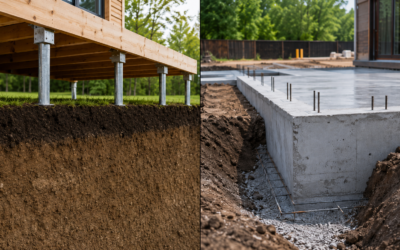
A screw pile foundation is installed with a hydraulic torque head rather than excavation equipment, which means it can reach sites that would be difficult or impossible to access with concrete forming and pouring equipment. Installation torque is monitored in real time, giving engineers a field-verified capacity reading for every single pile, which is critical for structures like transmission towers, where each foundation point needs to meet an exact, documented specification.
Because there’s no curing time, structures can be built immediately after piling is complete, which keeps tightly scheduled utility projects on track. And because screw piles cause minimal ground disturbance during installation, they’re well suited to the environmentally sensitive corridors that transmission and utility routes often pass through.
Case Study: Hut 8 Bitcoin Mining Facility, Medicine Hat, AB
Inland Screw Piling was contracted directly by Orbis Engineering to engineer, fabricate, and install foundations for the Hut 8 Bitcoin Mining Facility in Medicine Hat, Alberta, a project supporting 40 modular data centre units, transformers, a pipe rack, and a communications tower.
The scope included 709 screw piles, engineered and manufactured in-house at our Coaldale facility and installed to support the full range of structures on site. The project was completed two months ahead of schedule, and built on prior related work our team completed at the adjacent Unit 16 Power Plant.
For a project of this scale, supporting heavy modular infrastructure, transformers, and communications equipment on a single site, a screw pile foundation delivered the combination of speed, documented load capacity, and installation flexibility the project required.
Engineering and Certification Standards That Matter
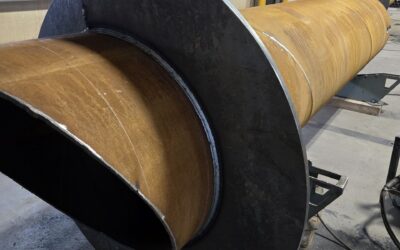
For utility and transmission work, foundation quality isn’t optional. Inland Screw Piling’s True Pitch™ helix screw piles are manufactured in-house under CWB-certified welding standards and G-CERT ISO 9001:2015 quality management, and our team holds ISNetworld and COR/AASP certification. Every pile is backed by in-house structural design and engineering, so the foundation specification on a transmission or utility project is built and verified by the same team from start to finish.
Working With EPCs and Project Engineers
Projects like Hut 8 are typically specified and managed by EPCs and project engineers who need a manufacturing partner capable of meeting exact engineering specifications, tight timelines, and rigorous documentation requirements, not just an installer. Inland Screw Piling’s in-house manufacturing, engineering, and QA/QC capability means project teams work directly with the people designing and building the product, from initial specification through to final installation.
If you’re an engineer or EPC planning a transmission, substation, or utility infrastructure project in Alberta, our team can walk through your site conditions, load requirements, and timeline to determine whether a screw pile foundation is the right fit.